An MSL walks out of a meeting with an academic oncologist and sits in the car for a minute before the next drive. The conversation covered the subgroup data from the Phase 3 readout. Near the end, the oncologist asked, without prompting, whether anyone had looked at dosing in patients on dialysis. In passing, she mentioned a patient on the product who developed a rash. If the note waits until Monday, the dialysis question will have drifted, the rash may not be in it at all, and nobody will be able to say who raised it.
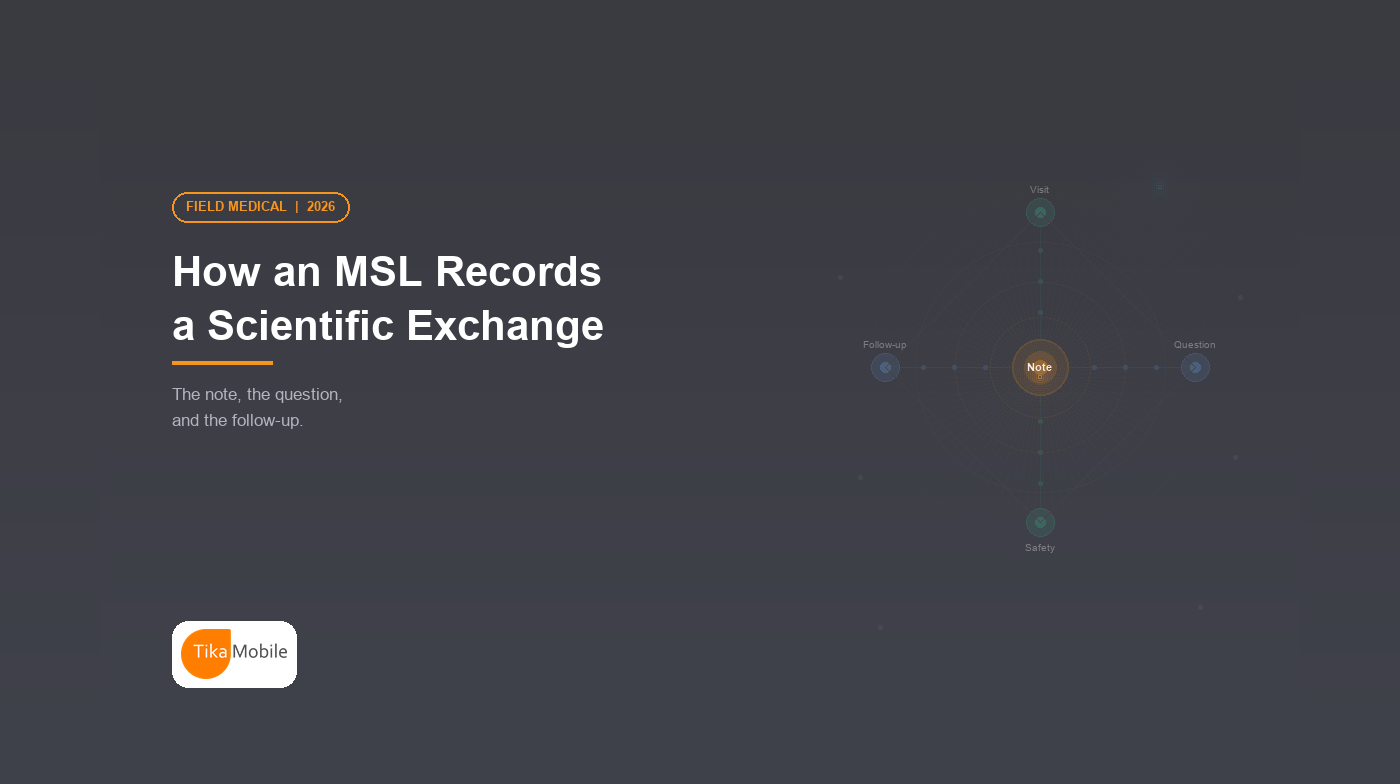
Scientific exchange is the non-promotional discussion of scientific and clinical data between a company's medical team and healthcare professionals; the glossary entry on scientific exchange covers the definition in full. This post is about what comes after the conversation, the record. It covers what an MSL should capture, when to write it, how to keep it scientific and compliant, and where each part of it goes next.
Quick answer: A scientific exchange record should show who the MSL met, when and how, who else was in the room, which topics were discussed and who raised each one, what was shared and in which version, any unsolicited question in the HCP's own words, any safety mention and when it was reported, and the follow-up owed. FDA's December 2011 draft guidance on unsolicited requests recommends keeping the nature of the request, the requester's name, address and affiliation, what was provided, and any follow-up. Write it as soon as you can after the meeting, inside the window the company's field procedure sets, and route the question, the safety mention and the insight to the teams that own them.
Why the record carries so much weight
A scientific exchange usually happens between two people with no one else listening, so the note is what remains. If someone asks whether an off-label discussion was proactive or reactive, whether a sales colleague prompted it, or whether a safety mention reached pharmacovigilance, the note is what answers.
FDA's draft guidance Responding to Unsolicited Requests for Off-Label Information About Prescription Drugs and Medical Devices, issued in December 2011 and still listed as a draft, is specific about this. It recommends that a firm keep records of the nature of the request, including the name, address and affiliation of the person asking, the information provided in response, and any follow-up questions.
The professional bodies say the same thing from the field's side. A 2021 position statement from APPA, IFAPP, MAPS and the MSL Society, published in Therapeutic Innovation & Regulatory Science, separates proactive engagement, which should never be for the purpose of providing off-label information, from reactive responses to bona fide unsolicited requests. Its key principle on off-label requests is short: they need to be documented in an appropriate way.
What goes in a scientific exchange record
Fields vary by company and CRM, but a defensible record answers the same questions. Here is one way to lay them out.
Who, when, how, and who else was there
The HCP, their institution and specialty, the date, and the channel: in person, video, phone, email, or at a congress. Then everyone else present. That last field is easy to skip, and it matters. The 2021 position statement says joint visits with a sales representative are for introductions, and that scientific exchange should happen outside joint interactions. If a rep was in the room, the record should say so.
The topics, and who raised each one
List the topics discussed and mark, for each, whether the MSL brought it up as part of the engagement plan or the HCP asked. This is the field a compliance reviewer will look for. A planned discussion of on-label data or a disease-state topic is proactive. An unapproved use can be answered only if the HCP asked on their own, and the record is where that fact lives.
What was shared, and which version
Name the approved slide deck, reprint or response document, with its version or approval code. If something was promised and sent later, record that too. FDA's January 2025 guidance on communications of scientific information on unapproved uses describes the same kind of separation: when a firm's representative shares that information in person, it should stay apart from promotional material shared at the same visit. FDA says this guidance is not for current implementation while it waits on a decision about the information collection, so the company's own procedure still governs. Naming exactly what was handed over is what makes the separation easy to show later.
The question in the HCP's words
When the HCP asks something, write the question as close to how they said it as you can. "Any data on dosing in patients on dialysis?" is a different question from "renal impairment," and the answer medical information prepares should match the narrow one.
What the MSL heard
Keep a separate place for observation: what the HCP thinks about the data, what is getting in the way for their patients, what they expect from a competitor's readout. That is the raw material for an insight. Keep it apart from the factual summary, since different people read each.
Safety mentions and follow-up
The 2021 position statement is clear that if an adverse event is mentioned in an interaction, the MSL reports it under the company's pharmacovigilance policy whether or not anyone thinks the product caused it. The visit record should note that a safety mention occurred and when it was reported, and the details belong in the safety report itself. Finish with the follow-up owed: what, by whom, and by when.
When to write it
As soon as you can after the meeting. Memory fades first on the details that matter most: who raised a topic, how a question was worded, whether a side comment was a safety event. No public standard sets the window, so follow the one in your field procedure.
Some MSLs dictate the note. Treat the dictated text as a draft: read it back, fix the misheard drug name, and check the question is quoted as asked before it becomes the record.
Bring one visit note from last week. In 20 minutes we can show the visit, the unsolicited question and the follow-up on one record in TikaMSL.
Book a 20-minute walkthrough →
Keeping the record scientific and compliant
Write what was discussed in scientific terms and leave commercial language out. Phrases like "agreed to use," "will switch patients," or "good prescribing potential" don't belong in a medical record, and an auditor reading them will assume the conversation sounded the same way.
Quote the unsolicited question and say it was unsolicited. Don't record the off-label answer in free text if the answer was routed to medical information, because then there are two versions of the response and only one was approved.
Keep patient details out of the visit note. The safety report carries what pharmacovigilance needs. The visit record only needs to show that a report was made.
Before launch the same discipline applies with less room for error, since everything discussed is investigational. See pre-launch field medical in Phase 3.
Where the record goes next
A good visit note often holds three things other teams own, and each needs its own hand-off.
The unsolicited question goes to medical information as a request. The response is prepared by medical or scientific staff, and FDA's 2011 draft says sales and marketing should have no input on its content. The medical information request workflow post covers what happens from intake to sent response.
The safety mention goes to pharmacovigilance under the company's own procedure and timeline.
The observation goes to the insights process. A visit note doesn't become an insight by itself. Someone has to write it as an insight, with context and the reason it matters. The post on field medical insights goes through what a usable insight looks like.
An edge case: the question that comes up in a joint visit
Say the MSL joins a sales colleague for an introductory visit, as the position statement allows, and the HCP asks about an unapproved use while the rep is still in the room.
The position statement puts scientific exchange outside joint meetings, so the MSL doesn't answer it there. The question is taken as a request and answered later, separately, through the medical route. The harder part is the record. FDA's 2011 draft treats a request as solicited if a sales representative mentions an unapproved use and invites the HCP to ask for more. If the rep said something just before the question, the MSL may not know whether it counts as a prompt. The honest answer is to write down what happened, in order, including what the rep said, and let compliance decide how to classify it. A record that guesses in the company's favor is worse than one that leaves the question open.
How TikaMSL holds the record
TikaMSL is TikaMobile's medical affairs CRM for medical science liaisons. It keeps the HCP and their tier, the scientific visit and its outcome, and eMIRF, which is the inquiry captured on that visit. A spoken note can become text in about 60 seconds, and the MSL checks it before it is the record. A question captured in the field can enter the TikaMedInfo queue, where the medical information team handles it as a case. An insight can be written in TikaInsights, which can run with TikaMSL and coaches the insight while it is being written. The visit note doesn't turn into a case or an insight on its own; each is a deliberate step. TikaMSL runs beside Veeva or Salesforce.
A team with a clear SOP and a CRM with the right fields can keep good records with any tool. Software changes how much of the SOP an MSL has to remember at the end of a long day.
Questions people ask
What should an MSL include in a scientific exchange record?
The HCP and their institution, the date and channel, everyone present, the topics discussed and who raised each one, the materials shared with their version, any unsolicited question in the HCP's own words, any safety mention and when it was reported, observations that may become insights, and the follow-up owed.
How soon after a visit should an MSL document the interaction?
As soon as practical after the visit. No public FDA or industry standard sets a number of hours, so the company's own field procedure governs.
Does an MSL need to document an unsolicited off-label request?
Yes. FDA's December 2011 draft guidance recommends keeping records of the nature of the request, including the requester's name, address and affiliation, the information provided, and any follow-up. A 2021 position statement from APPA, IFAPP, MAPS and the MSL Society also says off-label requests need to be documented in an appropriate way.
What happens if a sales representative was present when an off-label question was asked?
The MSL should record that the representative was present and what was said before the question, then route the question through the medical process rather than answering it in the joint meeting. FDA's 2011 draft treats a request prompted by a sales representative as solicited, so compliance decides how to classify it based on the record.
Does a visit note automatically become a medical insight?
No. A visit note records what happened. An insight is written deliberately, with context and a reason it matters to medical strategy, and goes through the company's insights process. The observation in the note is the starting point.
Before your next field ride-along
Pull five visit notes from last month and read them as an auditor would. Each should show who was present, who raised each topic, what was shared, and when any question or safety mention was handed off. If you'd like to see how a visit, its unsolicited question and its follow-up look on one record, we can walk through it with a visit your team had this month.
Book a 20-minute walkthrough →
Related reading: what scientific exchange means.
Sources
- U.S. Food and Drug Administration. Responding to Unsolicited Requests for Off-Label Information About Prescription Drugs and Medical Devices. Draft guidance, December 2011.
- U.S. Food and Drug Administration. Communications From Firms to Health Care Providers Regarding Scientific Information on Unapproved Uses of Approved/Cleared Medical Products: Questions and Answers. Final guidance, January 2025. FDA notes it is not for current implementation pending OMB's decision on the collection of information.
- Theron P, Britland M, Holder D, Ikeda Y, Rewers RF, Tiku A. Promoting Best Practices for Medical Science Liaisons: Position Statement from the APPA, IFAPP, MAPS and MSLS. Therapeutic Innovation & Regulatory Science. 2021;55(6):1139-1144.
Blog
October 28, 2026