A brand team plans forty dinner programs for the year. The speakers are the physicians the sales team knows best, the deck is last year's with a new date on the cover, and half the room attended in the spring. Nothing about that plan looks unusual from the inside. It is close to a list of what the government has called suspect.
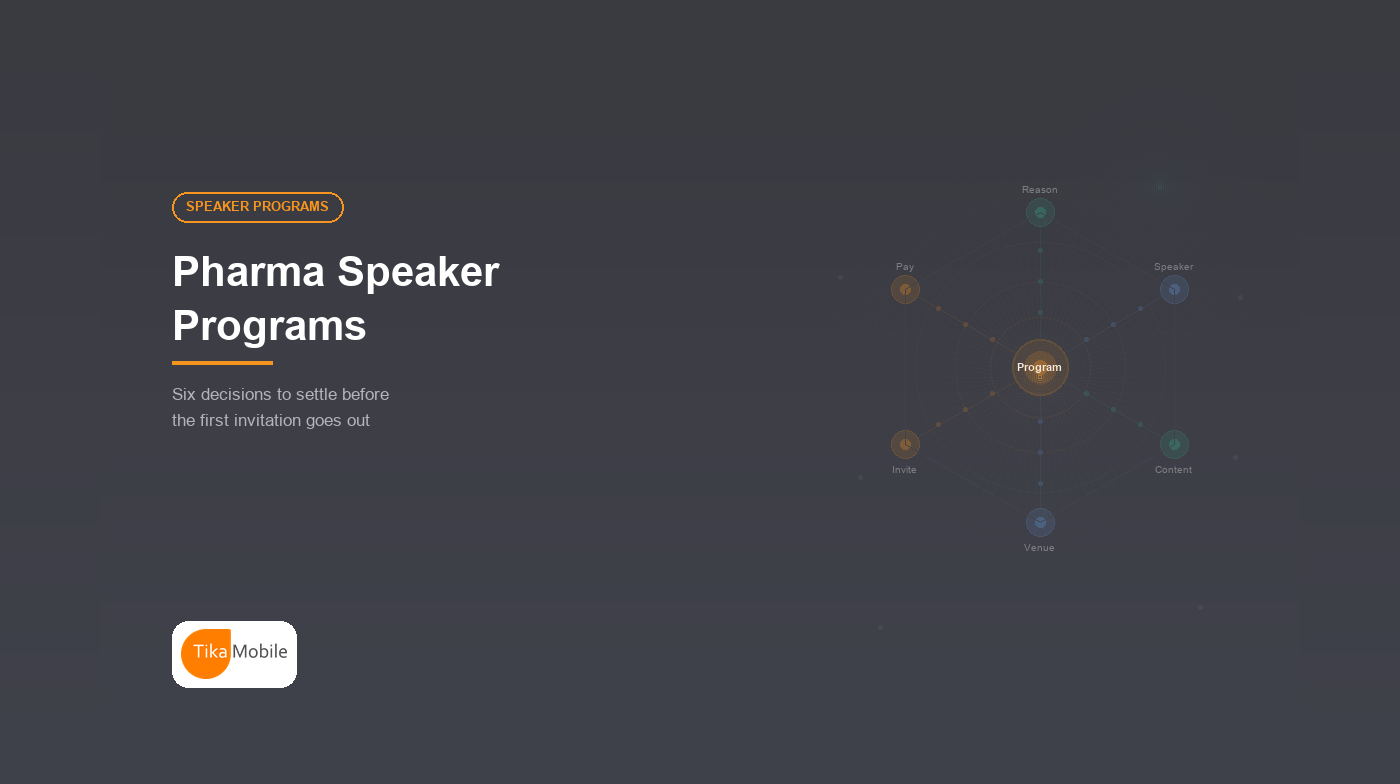
Pharma speaker programs are company-sponsored events where a paid health care professional presents company-approved content about a product or disease state to other clinicians. They are lawful and often useful. They also sit under the Anti-Kickback Statute, which is why the design of a program matters as much as what is said at it. This post covers the design: the six decisions a medical or commercial team should settle before the first invitation goes out.
Quick answer: A defensible speaker program has a documented educational reason to exist, speakers chosen for expertise by people outside sales, approved on-label content with a route for off-label questions, a modest venue with no alcohol, invitations limited to clinicians with a real educational need, and pay set at fair market value and checked against a cap before it is approved. The OIG's 2020 Special Fraud Alert and the PhRMA Code revisions that took effect in January 2022 are the two reference points most compliance teams design against.
Why speaker programs draw this much scrutiny
In November 2020 the HHS Office of Inspector General issued a Special Fraud Alert on speaker programs. Special fraud alerts are rare, and this one went further than listing bad practice. It questioned whether many programs had educational value at all. The characteristics it named as suspect include little substantive content, alcohol or meals beyond modest value, entertainment or high-end venues, many programs on a topic with no new information, repeat attendees, speakers selected by sales or on expected business, and pay above fair market value.
PhRMA responded by revising its Code on Interactions with Health Care Professionals, effective January 1, 2022. Companies should not pay for or provide alcohol at speaker programs. High-end restaurants are not appropriate venues. Repeat attendance on the same topic where a meal is served is generally not appropriate without a bona fide educational need, and guests without their own educational need should not attend.
Enforcement has kept going. In 2025 the government announced two settlements built around speaker programs, both summarized by Mintz. Gilead agreed to pay $202 million in April. The government alleged repeat attendance, sales influence over speaker selection, and monitors who didn't report when meal limits or venue rules were broken. Assertio agreed to pay $3.6 million in May over allegations that speakers were chosen for prescribing volume and paid above fair market value. In the Gilead matter the company had written policies and live monitoring. The allegation was that they weren't followed.
That last point is the one program owners should take into planning. A policy describes the program you meant to run. The record of each event is what shows the program you actually ran.
Six decisions to make before the first invitation
1. The reason the program exists
Write down what the audience needs to learn and why now. A new indication, new safety data, or a change in the treatment guideline is a reason. A sales territory that wants more face time is not one the OIG will accept. The same record should say when the program ends. A deck that has run unchanged for two years is the "stale content" the fraud alert describes, and retiring it is a decision someone has to own.
2. Who chooses the speakers, and on what
Selection criteria belong in writing before anyone is nominated: clinical expertise in the disease, publication or trial experience where it matters, presentation training, and a signed contract. Sales can suggest names. A medical or compliance owner should decide, and the reason should sit on the speaker's profile. If your team already tiers external experts for medical engagement, the KOL engagement strategy post covers how that tiering is built, and the same tier can set the speaker's rate.
3. What the speaker is allowed to say
Speakers present the deck approved in MLR review, on label. Attendees will still ask about uses that aren't approved, so decide in advance what happens then. The usual answer is that the speaker doesn't improvise and the question goes to medical information as an unsolicited request. If that route doesn't exist yet, the medical information request workflow is the place to start. Track the deck version on each event, so you can show which content was used where.
4. The room and the meal
The company should not pay for alcohol, and the meal should be modest. The venue has to be somewhere a presentation can actually happen. Under the PhRMA Code that can be a private room at a local restaurant, but a high-end restaurant, a resort, or a sporting event is out. Virtual and hybrid programs remove most of the venue question, though they still need the same attendance record.
5. Who is invited, and who comes back
Invitations go to clinicians with an educational need for this topic. Guests don't attend unless they are clinicians with their own need. Repeat attendance is where most programs lose track, because the second dinner is planned by a different rep in a different month. A sign-in that ties each attendee to one HCP record, with their NPI, is what lets the next program check who has already heard the talk. A speaker who attends a program on the topic they present is a repeat attendee too.
6. What the speaker is paid, and against what limit
Set the honorarium from a fair market value rate and the hours the program actually takes, plus reasonable travel. Then check the payment against the speaker's annual cap before it is approved, not when finance closes the quarter. The mechanics of that check, and why quarterly audits catch it too late, are in our post on speaker bureau FMV monitoring.
What the record should show after every program
If an auditor picks one program from last March, the file should answer these questions without anyone reconstructing it from email:
- Why did the program run, and what was the educational need?
- Who chose the speaker, and on what basis?
- Which deck version was presented?
- Who attended, and had any of them attended before?
- What did the venue and meal cost?
- What was the speaker paid, how was it calculated, and where did they stand against the cap at the time?
Payments to physicians for speaking are also reportable under the Sunshine Act through CMS Open Payments. The disclosure is only as good as the payment record behind it, so the same event file feeds both the audit and the report.
Bring one program you are about to contract. Twenty minutes is enough to see the speaker, the cap, and the invoice on the same record.
Book a 20-minute walkthrough →
Where TikaSpeaker Bureau fits
TikaSpeaker Bureau is TikaMobile's software for the speaker programs a company runs, including dinner programs, advisory boards, and grand rounds. Each program moves through Planned, Confirmed, Completed, and Evaluated on one record. The speaker's credentials, tier, training, and signed contract sit on their profile, and an alert fires before training lapses. Attendance is recorded by territory against the HCP's own profile, and a structured rating after each program makes quality comparable across events.
On pay, a completed event calculates the honorarium from preparation hours, service hours, and travel. The speaker confirms or disputes the invoice in a portal, and finance approves or rejects it with a stored reason. Caps can be set annually, quarterly, and per event by tier. The platform warns at 80 percent of a cap and blocks the payment at 100 percent, and going past the cap needs an exception reviewed by compliance. Changes to an event, a contract, an invoice, or an exception are logged with the person and the time. It runs on its own or beside the CRM a company already has, including Veeva or Salesforce.
One limit is worth stating plainly. Automated CMS Open Payments export, EFPIA disclosure files, and state transparency reports are not in the product yet. The payment record is there. The filing still runs through whatever process your company uses today.
When a spreadsheet is still enough
A company running a handful of programs a year, with one compliance reviewer who knows every speaker, can do this in a spreadsheet and a shared drive. The design decisions above matter more than the tool. What breaks is scale and turnover. Once programs run in several regions, or the person who knew which physician attended in April leaves, the record has to hold that memory instead of a person.
Questions people ask
What is a pharma speaker program?
A pharma speaker program is a company-sponsored event where a paid health care professional presents company-approved information about a drug, device, or disease state to other clinicians. Unlike accredited continuing medical education, the company controls the topic, the content, and the speaker, which is why the programs are treated as promotional and reviewed under the Anti-Kickback Statute.
Are speaker programs legal?
Yes. The OIG's 2020 Special Fraud Alert does not prohibit them. It warns that programs with little educational content, lavish meals or venues, repeat attendees, or speakers chosen and paid on the basis of business can create liability. Programs designed around a real educational need and documented as they run are the ones that hold up.
Can a company serve alcohol at a speaker program?
Under the PhRMA Code revisions effective January 1, 2022, member companies should not pay for or provide alcohol in connection with speaker programs. The OIG also lists alcohol as a suspect characteristic, particularly when it is free.
Can the same physician attend more than one speaker program?
Repeat attendance at a program on the same or substantially the same topic, where a meal is provided, is generally not appropriate under the PhRMA Code unless the attendee has a bona fide educational need. Tracking attendance against a single HCP record, often with the NPI on the sign-in, is how teams enforce that across regions.
Who should select speakers for a speaker program?
Selection should rest on written criteria such as clinical expertise and training, with the decision made by a medical or compliance owner rather than by sales. The OIG names selection by sales, or on the basis of past or expected prescribing, as a suspect characteristic, and it featured in the 2025 enforcement actions.
Before the next program is booked
Take the next program on your calendar and answer the six questions above for it, on paper, before the invitations go out. If any answer is "we'd have to check," that is the part of the design to fix first. If you want to see how the event, the speaker, the cap, and the invoice look on one record, we can walk through it with a program you are planning now.
Book a 20-minute walkthrough →
Sources
- HHS Office of Inspector General. Special Fraud Alert: Speaker Programs. November 2020.
- PhRMA. Statement on Revisions to the PhRMA Code on Interactions with Health Care Professionals. 2021, effective January 1, 2022.
- Mintz. Speaker Programs: Two Recent Enforcement Actions Serve as a Reminder of the Government's Longstanding Scrutiny. May 14, 2025.
- Centers for Medicare & Medicaid Services. Open Payments.
Blog
October 21, 2026