The board asks for field medical in the same quarter as the expected approval. The job description, the territory map, and the first advisory board land in one month. The MSLs meet the investigators who have already formed a view of the data. Pre-launch field medical is the work that should have happened before that quarter.
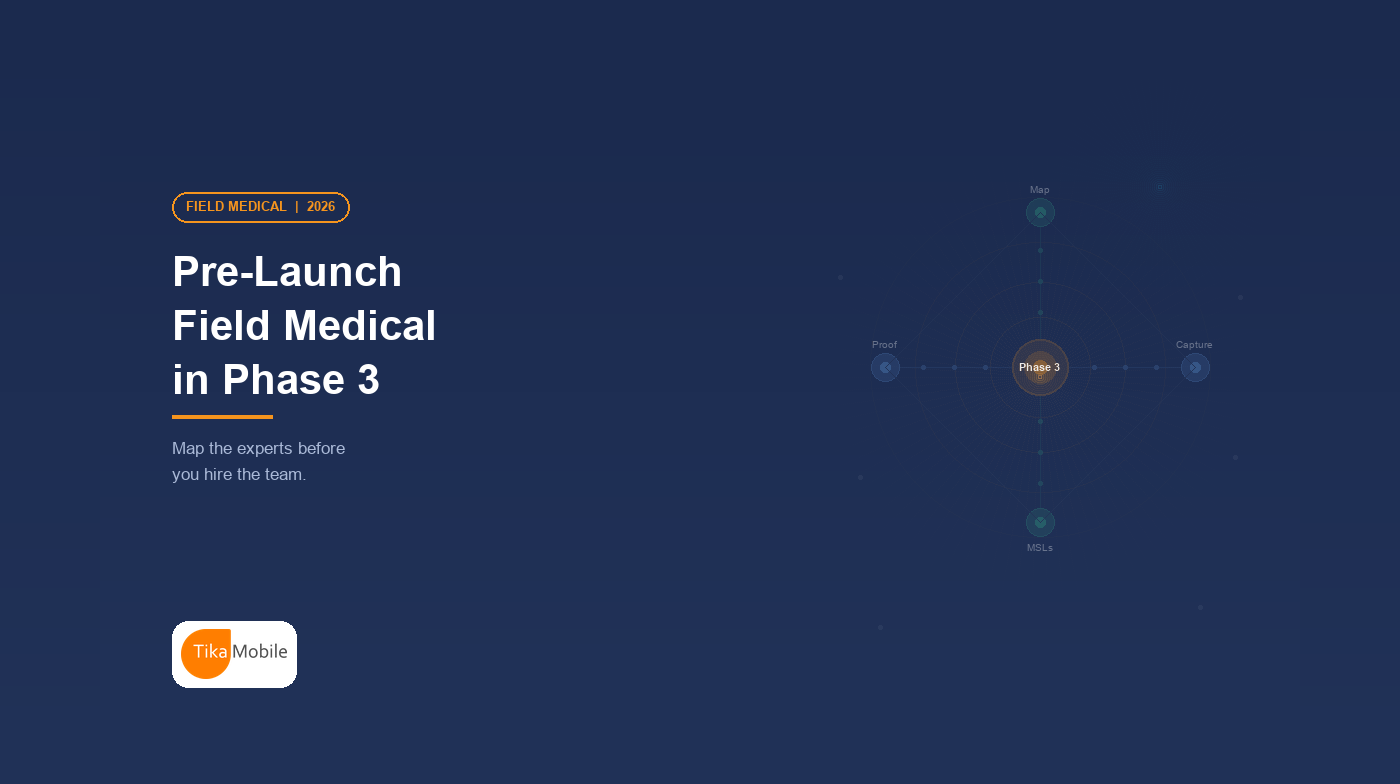
Pre-launch field medical is the field team's job while a therapy is still in Phase 3: learn the disease as it is actually treated, know who shapes that treatment, and bring those observations back in time to change a plan. It is not a smaller version of the launched team. There is no label to teach yet. IQVIA's 2019 launch-readiness white paper puts local medical science liaisons in seat 18 to 24 months before launch. Waiting for the approval year throws that window away.
Quick answer: Start pre-launch field medical in Phase 3. That means a named medical lead and the expert map, not a full MSL team on day one. Local MSLs follow about 18 to 24 months before launch (IQVIA, 2019). Map the external experts before that hiring. Capture what investigators say while the study is still enrolling. Keep every conversation scientific. You cannot pre-sell a product that is not approved.
Phase 3 is the window, and it is not one date
MAPS describes medical launch preparation as starting 48 to 24 months before approval. That stretch is the medical plan: evidence gaps, education, and who the organization still does not know. The next stretch, 24 to 12 months out, is where those plans get specific. The last year is execution against a decision date.
Field hiring sits inside that, and IQVIA splits it into three steps, all measured before launch. Global medical roles start at the beginning of Phase 3, typically 3 to 5 years out. Local medical leadership comes 2 to 3 years out. Local MSLs are in place 18 to 24 months out. A first-time biotech does not need a full regional team at the start of Phase 3. It does need a named medical lead, a map, and a place to put what investigators say, before anyone is hired to cover the country.
Oncology and rare disease can compress the early phases. The approval date is the clock, not the phase label. If Phase 3 will be short, start the map when the pivotal study is designed, not when the readout is scheduled. How that compression shows up in two indications is in the rare disease and oncology launch timeline.
What pre-launch field medical is allowed to do
Before approval, the conversation is scientific. Disease, standard of care, how a protocol fits a clinic, what a readout would have to show to matter. A 2021 presentation by Sanaz Cardoza, PharmD, then Senior Director at Mallinckrodt Pharmaceuticals, argues for involving MSLs during the trial, not only after the Phase 3 data. Investigators can tell you where recruitment and the protocol are hard. That friction is useless if it stays in one person's notebook.
What the team cannot do is preview a promotion. No implied claim, no "when we launch you will want this," no slide that only works if the listener forgets the product is unapproved. The credibility of the launched team is whatever was true in these earlier meetings.
Four things, in this order
1. The map, before the headcount
Write down who actually shapes the indication. Investigators on the pivotal study. People who will influence a guideline. Community physicians who treat the patients and do not publish. A list built only from papers misses the second and third groups, and those are often the ones a launch will depend on.
Finish a first version of that map while the study is still running. Hiring MSLs to go discover it is how the first two quarters disappear. The work continues on the KOL identification page.
2. A place for what was said
The earliest conversations are often the frank ones, and they happen before a field team exists. An investigator mentions that sites will not enroll a subgroup. An advisor says the endpoint will not match how they choose treatment. If that sentence lives in a follow-up email, it will not be in the room when the publication plan is set.
Give those comments the same shape you will want after launch: who said it, what was said, why it matters, and whether anyone acted. Field medical insights are that record once the team is in the field. The habit has to exist before the first MSL is hired.
3. Hire against a plan
By the time local MSLs are in seat, which IQVIA puts at 18 to 24 months before launch, the map should already say who is in scope and what the organization still needs to learn. MSLs onboard to that map instead of spending their first months building the context headquarters should have handed them.
An engagement plan, at this stage, is a short list. Which scientific questions will be taken to which people. What progress means before a label exists is an expert willing to look at the data with you. There is nothing to adopt yet, so don't measure it as if there were. The later operating rhythm is the KOL engagement strategy post. Do not invent a second one here.
4. A decision you can name
A pre-launch team has a cost and no revenue. Call counts will not survive a budget review. What survives is a decision that changed because of something the field heard. A subgroup the protocol struggled to enroll. An evidence gap that moved a publication. A pathway comment that changed the scientific narrative.
If you cannot name one, say so. A dashboard of meetings taken is not a value story.
What "done" looks like before approval
| When | The work | Done when |
| Start of Phase 3 (IQVIA: typically 3–5 years before launch) | A named global medical lead; the expert map started | Investigators, guideline voices, and non-publishing treaters are listed. Gaps are explicit. |
| 2–3 years before launch (IQVIA) | Local medical leadership in place; capture running with a small team | Investigator comments are stored with a source and a next step, not left in mail. |
| 18–24 months before launch (IQVIA) | Local MSLs in seat, onboarding onto the existing map | The first month is visits against a plan, not building the plan. |
| Final 12 months before approval (MAPS) | The narrative and the proof | At least one launch decision cites something the field heard. Activity totals are not the proof. |
The months come from IQVIA (before launch) and MAPS (before approval). They are planning ranges, not a promise that every therapy gets the same calendar. A short pivotal study pulls the map earlier. A delay in filing does not mean the capture stops.
If this is the build you are in, the field workflow sits in medical affairs. TikaMSL, TikaMobile's medical affairs CRM, is where those MSLs work once they are hired, including beside a CRM the company already runs.
See the map, the capture, and the plan in one walkthrough.
Book a 20-minute walkthrough →
Questions people ask
When should a company start pre-launch field medical?
During Phase 3, not in the approval year. IQVIA's 2019 medical launch-readiness white paper puts local MSLs in place 18 to 24 months before launch. MAPS starts the wider medical plan earlier, 48 to 24 months before approval. A first field team does not have to be fully staffed at that earlier mark. The map and the capture should be.
What can field medical do before the product is approved?
Scientific work only. Disease education, dialogue with investigators about the study and the data, advisory discussion, and a record of what was heard. Promoting an unapproved product, or speaking as if approval and a label already exist, is outside the role.
How do you justify the team before there is revenue?
Name a decision the field changed. An evidence gap, a protocol friction, a pathway comment that altered the scientific narrative. A count of meetings does not answer a board that is paying for a team with nothing to sell yet.
How is this different from field medical after launch?
Before approval the audience is narrower and the content is not a label. Investigators and the people who will interpret the readout come first. After approval the same relationships are what make a broader field team credible. Starting both jobs in the same quarter is how the launched team spends its first year learning names.
Should a Phase 3 biotech hire or outsource its first MSLs?
Either can work. IQVIA notes that outsourcing medical roles ahead of the data read-out is emerging as a way to stay flexible while the outcome is uncertain. Whichever model you choose, keep the expert map and the record of what investigators said inside the company, so a vendor change or a post-readout hiring decision doesn't reset the relationships.
If Phase 3 is underway and the map does not exist
The expensive version of this story is told after launch, when the relationships are late. The fix, if the pivotal study is open now, is the map and a place to store what investigators are already saying. Headcount follows that, on the 18-to-24-month line, not the other way around.
Book a 20-minute walkthrough →
Sources
- Gores M, Dyce G, Korac Trkulja A. Medical Launch Readiness: Making or Breaking a Successful Launch. IQVIA white paper, 2019.
- Medical Affairs Professional Society. Launch Excellence.
- Cardoza S, Mallinckrodt Pharmaceuticals. Opportunities for MSLs to Deliver Value and Provide Key Insights to the Organization in the Pre-Launch Phase. Presentation, 2021.
October 13, 2026