Most KOL engagement strategies fail in the second month, and the failure is boring. Global medical writes a list of experts. The MSL opens a different list on Monday, the one that matches the territory, the congress, and the two people who actually returned the last email. The slide and the week never meet.
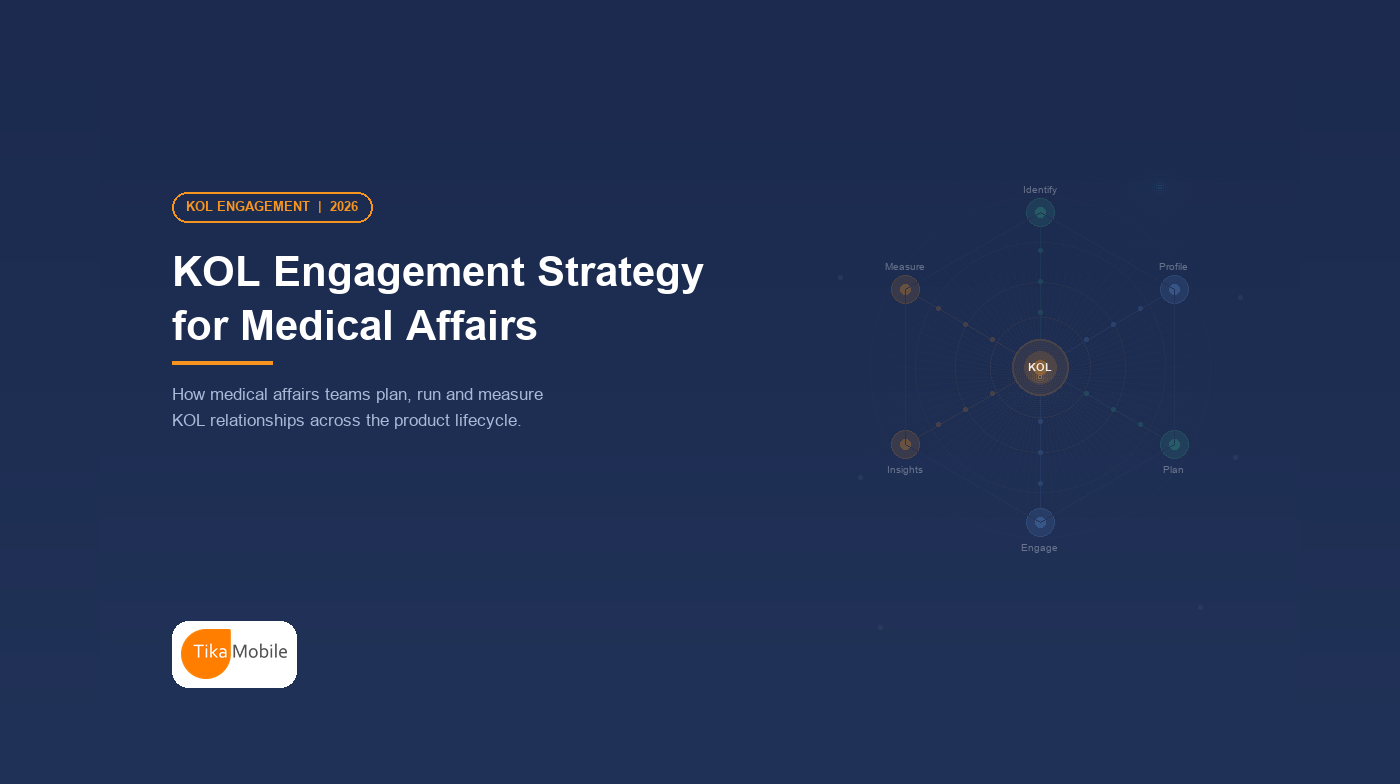
Quick answer: A KOL engagement strategy is the medical affairs decision about which scientific questions need an external expert, which experts are in scope, what a compliant conversation is allowed to be, and what the company will do with the answer. A KOL engagement plan is that decision written down for one expert or one tier, with an owner and a date. Neither is a call quota, and neither is a target list.
Start with the question you cannot answer internally
Field medical's job, in the MAPS 2024 standards on external scientific engagement, is to hold scientific exchange and to bring back what external experts know that the company does not. Key insight topics and key insight questions are supposed to be set, globally or regionally, before the visit. Teams that skip this step fill the quarter with experts who were easy to book.
Write the question in one sentence a medical director would recognize. "Where do community oncologists still hesitate after the label update?" is a question. "Maintain relationships with top KOLs" is a mood. If two MSLs on the same asset would plan different meetings from your sentence, it is not done.
Lifecycle changes the question. That is the useful part of the data-heavy guides already ranking. Before launch, you need people who can tell you whether the evidence matches practice. After launch, you need people who see the gaps the trial did not enroll. A strategy that keeps the same twenty names from phase 3 through year three is a reunion, not a plan. (If your team is still coordinating that plan across channels rather than writing it down, the omnichannel KOL engagement playbook covers the channel side; this article covers the plan itself.)
A target list is not a plan
The list is who might matter. The plan is why this person, this quarter, for this question. Consultancy write-ups often split the work into strategy, objectives, tactics, and measures. That split is a decent checklist. It still produces a spreadsheet of names with a column called "objective" that says "scientific exchange."
Fill five lines. Leave the page alone until those five are real.
| Line | What "done" looks like |
| Scientific question | One sentence. Tied to an evidence gap, a label question, a safety question, or a practice question. |
| Expert and tier | Name, tier, and the reason for the tier. "National" is not a reason. |
| Interaction | One meeting, an advisory board, a congress conversation, or a data discussion. Pick one. |
| Boundary | What this interaction is not. No promotional ask. No disguised speaker recruitment. |
| Insight | Who inside the company receives it, and by which date. |
That page is the KOL engagement plan. The strategy is the set of questions and tiers that generated it. If you cannot fill the boundary line, you are looking at a commercial plan that has wandered into medical affairs.
Give the tier a job
Tiering collapses when every tier gets the same motion: a visit. A global expert might be the right person for one advisory board and a poor use of monthly field time. A regional clinician might be the only person who can tell you how the regimen actually gets administered on a Thursday. A younger investigator might belong on a methods discussion, not on a legacy advisory board built in 2022.
TikaMobile's glossary on KOL tiering is the place for the tier definitions. Use it. This article does not invent a second model. What belongs here is the assignment. Once the tier exists, the engagement strategy has to say what that tier is for. An expert with no job in the plan is a name you are afraid to delete.
Identification sits upstream of this work. Publications, trials, and congress roles are public signals. They are not the relationship. Published research on data-driven engagement makes the point from the data side: teams over-weight experts they already know, and a wider cut of public activity is how you notice someone you have never met. The engagement strategy starts after that cut. If the only people on the plan sat on last year's board, the identification work never reached the field.
Write the visit as scientific exchange
Medical affairs can brief, listen, and answer unsolicited questions. It cannot hand the expert a promotional job and call the hour a scientific exchange. Paid work, when it exists, sits at fair market value, with a contract and a record. That is a speaker-program and consulting problem. It has its own page, and it should stay there.
The test in the car afterward is plain. Could this conversation be described to a compliance partner without a wince? Did the MSL learn something the company did not already believe? Did the expert get a straight answer, including "we don't have that data"? A plan that only counts the meeting will train people to hold meetings.
Assign the week one question and one follow-up. A plan that stacks four objectives onto a thirty-minute call gets executed as whichever objective was easiest to say out loud.
Record the insight before the day ends
MAPS is clear that insights from field medical are input to decisions, not a diary. The failure mode is a note that says "good discussion," and a medical director who hears about the hesitation three months later, in a QBR, with the name detached from the sentence.
Same-day recording is the operating rule. Not because a form demands it. Because the qualifier the expert used ("I'd use it in fitter patients, not in the ones I actually see") is gone by Friday. The note needs the question, the answer, whether it confirms or challenges the internal view, and whether anyone must act. An adverse event or a product-quality complaint mentioned in passing has to move into the safety or quality path. A KOL note is the wrong drawer for that.
This is where a medical affairs record earns its place beside the CRM the company already runs. TikaMobile's KOL management software stores the engagement plan, the tier, and the interaction outcome on the expert record. TikaInsights can take field notes, including notes that arrive from Veeva CRM, and on save it can classify sentiment and suggest a next step. Voice capture on that flow averages about a minute. None of that chooses the scientific question. It stops the answer from living in one inbox.
Measure a decision, not a meeting count
Activity numbers have a job. They tell you whether the team had time to do the work. They do not tell you whether the work mattered. One coaching model used in medical affairs splits this into capacity (did we show up), quality (right person, right question, insight actually captured), and outcome (what changed). Use the split. Do not adopt a satisfaction score you do not collect and then call it a medical KPI.
Review a medical affairs KOL engagement strategy on four questions each quarter.
- Did we pursue the scientific questions we wrote down, or did the calendar fill with whoever was available?
- Did any insight change a label discussion, a study idea, a medical-information answer, or a field briefing? Name the decision. If you cannot name one, say so.
- Which planned experts were never contacted, and was that a capacity problem or avoidance?
- Which experts should leave the plan because the question moved on?
The longer argument about measures is in TikaMobile's KOL engagement ROI framework. Read that when leadership wants a number for "impact." Use the meeting checklist when the plan has already named the person and the MSL needs the hour itself to go well. This article stops at the plan.
Where the strategy breaks after it leaves the slide
The global list and the territory list diverge, and nobody is allowed to delete a name. Give the MSL a written rule for who can be paused. Otherwise the official plan is theater, and the real plan is memory.
Commercial and medical both "own" the same expert and log different goals. The engagement strategy should state the medical objective in one line a commercial lead can read. Shared names are normal. Shared call objectives are how a scientific visit turns into a compliance problem.
The advisory board produces a dozen themes and no owner. A theme without a person and a date is a poster. Assign a few, with dates, or you have assigned none.
There is a sharper failure. The plan is a speaker roster with the word "engagement" on the cover. If the success metric is the number of talks booked, you are not writing a medical affairs strategy. You are writing a program. Keep it with the people who run fair-market-value review.
If the plan is still a spreadsheet and the insight is still a free-text note, walk through engagement planning on the expert record.
Book a 20-minute walkthrough →
Questions medical affairs teams actually ask
What is a KOL engagement strategy?
A KOL engagement strategy states which scientific questions medical affairs will take to external experts, which experts are in scope, how those interactions stay within scientific exchange, and how insights get to a decision. It is not a target list and it is not a minimum number of calls.
What is the difference between a KOL engagement strategy and a KOL engagement plan?
The strategy is the set of questions, tiers, and rules for the asset or the therapeutic area. The plan is the one-page version for a specific expert or tier: the question, the interaction, the boundary, and who receives the insight by when. A strategy with no plans never reaches an MSL's week. Plans with no strategy become a pile of meetings.
How should a team measure KOL engagement?
Separate capacity from quality from outcome. Check whether the team had the conversations it planned. Then check whether the right question was asked and whether an insight was recorded the same day. Then name any decision the insight touched. A meeting count alone will make the calendar look successful while the scientific question goes unanswered.
How often should the plan change?
Review it when the evidence changes, when a quarter ends, and when a planned expert has been skipped twice. Editing the plan every Friday is not the same thing as keeping it current. A current plan is one you are willing to shrink.
Can this sit next to the CRM we already use?
Yes. Many teams keep their commercial CRM and still need a medical record of the question, the tier, the interaction, and the insight. TikaMobile can store that engagement on the expert record, and TikaInsights can ingest interaction notes that originate from the systems the rest of the company already runs. The strategy does not require you to pull out the system the rest of the company runs.
Put the plan where Monday happens
A strategy that lives in a slide will lose to the calendar. The expert record has to show the question, the tier, the last interaction, and whether an insight is still unassigned. That is the work of KOL management software, and it belongs on the product page rather than in a second essay.
If your team is deciding whether that record should live in TikaMobile, a 20-minute walkthrough is enough to see engagement planning and tiering.