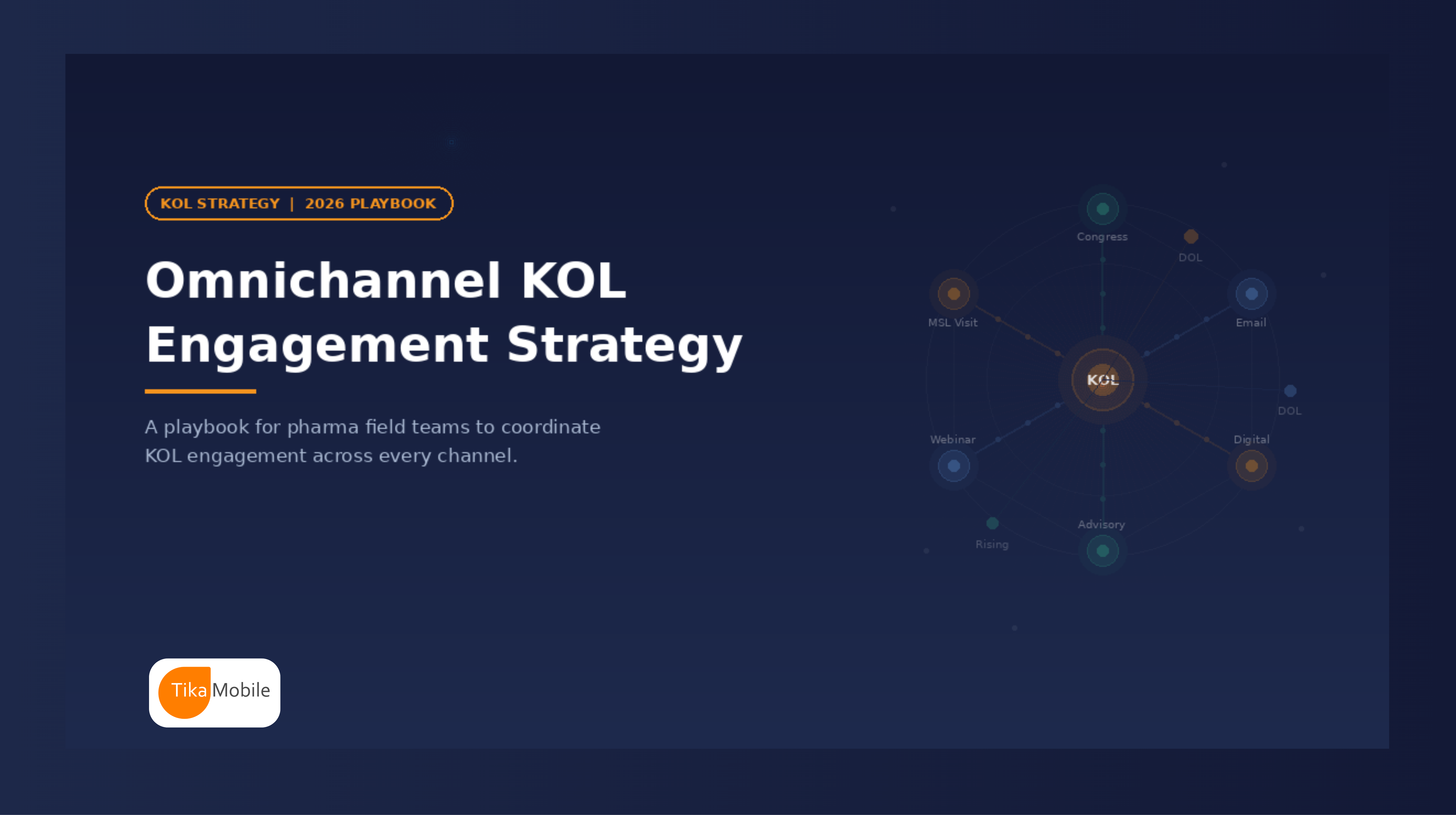
Omnichannel KOL Engagement Strategy: A 2026 Playbook for Pharma Field Teams
Most pharma companies have an omnichannel KOL engagement strategy on paper. Few have one that their MSLs actually use. The gap between the PowerPoint deck and the field team's daily workflow is where KOL relationships — and the insights they generate — quietly break down.
That gap is closing. In 2026, the tools, data infrastructure, and organizational alignment needed to run a genuinely coordinated KOL engagement program are finally available. The question is no longer whether omnichannel engagement matters. It's whether your team can execute it before your competitors do.
This playbook covers the four areas where execution separates leaders from laggards: defining omnichannel correctly, building the field-team capabilities that make it real, integrating digital opinion leaders into your KOL program, and measuring outcomes that actually reflect relationship quality.
What Omnichannel KOL Engagement Actually Means — and What It Doesn't
Omnichannel KOL engagement is a strategic approach that places the key opinion leader's experience at the center, integrating digital, in-person, and asynchronous channels into a coordinated journey. Every touchpoint — from an MSL's pre-call preparation to a post-conference follow-up email — builds on the last and informs the next.
This is not the same as multichannel engagement. Multichannel means being present on multiple platforms: email, conferences, webinars, advisory boards. It says nothing about whether those channels are connected. In practice, most multichannel programs operate as separate workstreams with separate teams, separate content libraries, and separate data stores. The KOL receives fragmented outreach that doesn't reflect a coherent relationship.
The distinction matters because the failure mode is specific. Teams that confuse channel proliferation with omnichannel engagement end up adding more touchpoints without adding more value. KOLs notice. They consistently cite relevance and quality — not frequency — as the primary drivers of a productive relationship with pharma companies.
Why 2026 Is Different
The pharma industry has talked about omnichannel engagement for years. What makes this moment distinct is that three enablers have matured simultaneously.
First, CRM adoption among Medical Science Liaisons has reached a tipping point. Platforms purpose-built for Medical Affairs — rather than repurposed commercial CRMs — are driving higher adoption rates because they embed intelligence into the MSL's natural workflow rather than requiring a separate data-entry step.
Second, AI-powered KOL profiling tools now pull from multiple data sources in real time. Publication records, clinical trial participation, conference activity, and digital influence can be scored and updated continuously. This eliminates the annual KOL-mapping exercise that was always outdated by the time it was finished.
Third, HCP digital behavior has permanently shifted. Physicians engage with three times more digital content than they did three years ago. Eighty percent of physicians say they highly value personalized information from pharma over generic materials. The demand side is ready for omnichannel — the supply side needs to catch up.
The Expanded KOL Universe
The definition of "KOL" itself has broadened. Engagement strategies that focus exclusively on traditional academic thought leaders miss two categories that increasingly shape clinical practice and peer influence.
Digital opinion leaders (DOLs) are HCPs who disseminate influence primarily through social and digital channels rather than through journals or congress podiums. A DOL is, at its core, a KOL whose distribution channel is different — but whose influence on peer behavior is equally measurable.
Rising stars are early-career HCPs with growing publication records and expanding digital presence. They represent the next generation of thought leaders, and engaging them early — before every competitor has identified them — creates a durable relationship advantage.
A 2025 MAPS roundtable confirmed that DOLs are now key conduits for HCP audiences, providing accessible content on treatment guidelines, clinical trial outcomes, and novel therapeutics. Any omnichannel strategy that doesn't account for all three stakeholder categories is working with an incomplete map.
Why Most Omnichannel KOL Strategies Stall — and How Field Teams Break Through
The strategy document is rarely the problem. The problem is what happens between the strategy and the field medical team's Tuesday morning. Three execution barriers account for most failures.
The Data Silo Problem
Roughly 70% of MSLs report that their systems do not integrate data from multiple sources. KOL profiles live in one place, CRM field notes in another, publication data in a third, and medical information inquiry records in a fourth. When an MSL prepares for a KOL meeting, they're assembling a profile manually from fragments — and about half say their CRM data alone doesn't effectively help them prepare.
This fragmentation starves every downstream capability. You can't personalize content if you don't know what the KOL has already received. You can't recommend a next-best-action if you can't see the full engagement history. You can't measure relationship quality if the data is scattered across disconnected systems.
The CRM Adoption Friction
The second barrier is subtler and more damaging. When CRM tools create friction — requiring separate login workflows, manual data entry, or desktop-only access — field teams underuse them. And underused CRMs create a vicious cycle: poor data in means poor intelligence out, which makes the CRM feel even less valuable, which further reduces adoption.
This is the core tension that separates effective omnichannel programs from aspirational ones. The platform has to be worth using from the MSL's perspective — not just from leadership's reporting perspective.
Five Capabilities That Make Omnichannel Work
Breaking through these barriers requires five integrated capabilities, not five separate initiatives.
Deep KOL profiling and data-driven tiering. A three-tier model — global/national thought leaders (Tier 1), regional experts and emerging voices (Tier 2), local influencers and community advocates (Tier 3) — provides the segmentation backbone. But tiering only works if it's dynamic. AI-enriched scoring that updates based on publications, trial participation, conference activity, and digital influence replaces the static annual list that was always based on existing relationships rather than objective data. TikaMobile's AI-powered KOL identification uses this approach to surface previously unknown clinical investigators alongside established names.
Channel orchestration across in-person, digital, and on-demand. The channel mix for cr includes MSL visits, virtual advisory boards, email with personalized scientific content, webinars, scientific content hubs, congresses, and social media for DOLs. The orchestration challenge is ensuring consistent narrative across all of them — and matching channel to KOL preference rather than defaulting to whatever is easiest for the company.
Personalized, insight-driven scientific content. Content must offer genuine scientific value that addresses the KOL's specific research interests, not generic slide decks. Modular content — broken into reusable components that can be recombined for different channels and personas — is the operational model that makes personalization scalable. Ninety-one percent of Medical Affairs leaders expect AI and analytics to most significantly impact medical communications.
AI-powered analytics and next-best-action. Half of Medical Affairs leaders cite predictive insights as a top AI application. In practice, this means KOL scoring updates in real time, engagement trend forecasting, and next-best-action recommendations served to MSLs at the point of interaction — not in a weekly report they may never open. Platforms like TikaMSL's Medical Affairs CRM embed these recommendations directly into the MSL workflow.
Compliance architecture and audit-ready workflows. All digital engagement must use secure platforms, pre-approved content, and audit-ready communication logs. This is especially critical when Medical Affairs and commercial channels share data — cross-functional data sharing must maintain mandated separations to manage off-label risk.
What Good Looks Like: A Composite Scenario
The following is a fictional composite based on common field-team patterns.
NovaBio is a mid-size specialty pharma company launching a rare-disease therapy. Before implementing an omnichannel approach, their KOL engagement looked like this: MSLs maintained personal spreadsheets of KOL contacts. Advisory board invitations went to the same 15 names every year. Medical insights were captured in free-text email summaries that no one could search. Conference follow-ups happened inconsistently, depending on individual MSL initiative.
After consolidating KOL profiling, field CRM, and insight management into a single platform, NovaBio's Medical Affairs team saw three shifts within two quarters. First, AI-driven profiling identified 12 Tier 2 KOLs who had been invisible in the previous relationship-based mapping — three of whom became principal investigators for a post-market study. Second, MSL pre-call preparation dropped from 45 minutes of manual research to 10 minutes, because the platform surfaced recent publications, past interactions, and recommended talking points automatically. Third, insight capture rates doubled because logging happened inside the interaction workflow rather than as a separate administrative task.
Digital Opinion Leaders and KOLs: Building a Blended Stakeholder Program
Most pharma companies manage DOL engagement and KOL engagement as separate workstreams — separate teams, separate budgets, separate measurement. This siloed approach misses the intersection where the most value sits.
DOL vs. KOL: Different Channels, Complementary Influence
A thought leader who publishes in peer-reviewed journals and presents at international congresses reaches a different audience, through a different mechanism, than one who posts clinical commentary on social media to a community of 50,000 engaged HCPs. But their influence on treatment decisions can be equally significant.
DOLs provide two things that traditional KOL programs often lack. First, real-time insight into what topics and formats resonate with the broader HCP community. Second, access to a ready-made audience of engaged practitioners who trust the DOL's clinical judgment.
Traditional KOLs, meanwhile, provide the academic credibility and institutional influence that DOLs may not carry. A KOL engagement program that connects both — where a DOL's social reach amplifies a traditional KOL's congress presentation, or where a traditional KOL's advisory board input shapes the educational content a DOL delivers — creates compounding value that neither program achieves alone.
Compliance Guardrails for DOL Co-Creation
The compliance considerations for DOL engagement are real but manageable. Three principles apply.
First, DOL co-creation programs — such as co-developing educational webinars or contributing to patient Q&A sessions — should operate through a compliant portal that supports long-term engagement without constant transactional contracting. This reduces both administrative burden and regulatory risk.
Second, content produced through DOL collaboration must go through the same medical-legal-regulatory review process as any other external communication. The channel is different; the compliance standard is not.
Third, traditional KOLs who want to expand their digital presence represent a distinct opportunity. Helping established KOLs understand compliant use of digital channels to increase their reach is a "pull" that strengthens the relationship and extends the KOL's own influence.
Measuring What Matters: From Activity Counts to KOL Engagement Outcomes
Ask most Medical Affairs teams how they measure KOL engagement, and you'll get a list of activities: meetings held, emails sent, advisory boards attended, congress interactions logged. These are lagging indicators. They tell you what happened, not whether it mattered.
Between 67% and 70% of Medical Affairs leaders say they want KPIs that focus on qualitative impact — the quality of HCP relationships and the value of insights gathered. The gap between what leaders want to measure and what their systems actually track is one of the largest unresolved problems in Medical Affairs operations.
Leading vs. Lagging Indicators
Lagging indicators (activity metrics) include: number of KOL meetings per quarter, emails sent, advisory board sessions held, conference booth interactions. These are easy to count and operationally necessary — but they measure effort, not impact.
Leading indicators (outcome metrics) include: insight quality and novelty scores, KOL relationship strength ratings (via periodic surveys or structured feedback), publication co-authorship rates, advisory board input that influenced a strategic decision, and KOL Net Promoter Score. These are harder to capture but far more diagnostic.
The shift from lagging to leading indicators isn't just a measurement preference. It changes behavior. When MSLs are measured on insight quality rather than meeting volume, they prepare differently, ask better questions, and capture richer field intelligence.
Building a KOL Engagement ROI Model
ROI in KOL engagement has historically been treated as unmeasurable. That's changing. Industry benchmarks from IQVIA suggest that large pharma companies can conservatively model $25–35 million in annual value from structured KOL engagement platforms. Technology and enablement investments typically represent 15–25% of that retained value in standard therapeutic areas, rising to 30–35% in rare disease.
A practical ROI model for Medical Affairs teams starts with three inputs:
- Time recovered. Calculate the hours per week MSLs spend on manual KOL research, data entry, and report generation. Multiply by team size and fully loaded cost. Platforms that automate pre-call intelligence and post-call documentation can recover 20–30% of an MSL's administrative time.
- Insight yield. Track the number of field insights captured per quarter, the percentage classified as strategically actionable, and the number that influenced a medical strategy or regulatory decision. Companies with mature CRM adoption retain more than 70% of modeled insight value.
- Relationship continuity. Measure KOL retention across product lifecycle stages and the cost of re-establishing relationships that lapsed due to personnel turnover or engagement gaps. An omnichannel approach — where the relationship lives in the system, not just in the MSL's memory — directly reduces this cost.
Key Questions Answered
What is the difference between omnichannel and multichannel KOL engagement? Multichannel engagement means using multiple platforms — email, conferences, advisory boards, webinars — to reach KOLs. Omnichannel engagement coordinates those channels into a connected journey where every touchpoint builds on the previous one and informs the next. The core difference is integration: multichannel is about channel presence, omnichannel is about stakeholder experience. In practice, most pharma companies operate multichannel programs and call them omnichannel, which is why KOLs still experience fragmented outreach from even the largest organizations.
How do you identify and tier KOLs for a pharma product launch? KOL identification for product launches uses a three-tier model. Tier 1 includes global and national thought leaders — international congress speakers and widely cited researchers who shape treatment guidelines. Tier 2 covers regional experts, multicenter trial participants, and regional symposium leaders. Tier 3 includes high-volume local clinicians who drive community-level adoption. AI-powered platforms score KOLs across publication records, clinical trial participation, conference presentations, digital influence, and peer-network centrality — replacing the relationship-based lists that were always limited and potentially biased.
What channels should MSLs use to engage KOLs in 2026? The effective channel mix includes in-person MSL visits for deep scientific exchange, virtual advisory boards for structured input, personalized email with scientific content, on-demand webinars and content hubs, congress engagements, and social media for digitally active KOLs. Channel selection should be driven by KOL preference data, not internal convenience. Younger KOL cohorts increasingly prefer on-demand and asynchronous formats, while established thought leaders may prefer structured face-to-face interactions. The key is matching channel to person, not defaulting to a single format.
How do digital opinion leaders (DOLs) fit into KOL strategy? DOLs are HCPs who influence clinical practice primarily through social and digital channels. They complement traditional KOLs by providing real-time insight into HCP community interests and access to engaged practitioner audiences. Effective programs integrate DOLs and KOLs rather than managing them separately — for example, using DOL reach to amplify traditional KOL congress content, or using DOL community feedback to shape advisory board agendas. Compliance requirements for DOL co-creation programs mirror those for traditional KOL engagement: pre-approved content, documented interactions, and transparent contracting.
How do you measure ROI of KOL engagement in Medical Affairs? KOL engagement ROI combines three dimensions: time recovered (hours saved on manual research, data entry, and reporting), insight yield (volume and strategic quality of field insights captured), and relationship continuity (reduced cost of re-establishing lapsed KOL relationships). Industry benchmarks suggest large pharma companies model $25–35 million in annual value from mature KOL engagement programs. TikaMobile's platform supports this measurement by tracking engagement outcomes — not just activities — across the full KOL lifecycle.
How does AI improve KOL identification and engagement? AI contributes at three levels. At the identification stage, machine learning analyzes publication records, trial databases, conference activity, and digital presence to score and tier KOLs objectively — surfacing emerging voices that relationship-based mapping would miss. At the engagement stage, AI recommends next-best-actions for MSLs based on the KOL's recent activity, content preferences, and interaction history. At the insight stage, natural language processing extracts themes from free-text CRM notes — unlocking what industry practitioners call the "dark data" of field medical interactions.