A speaker program closes, finance pays the honorarium, and the meal receipt goes in a folder with the sign-in sheet. The following March that folder has to become rows in CMS Open Payments. The rows are a different object from the invoice. Each covered recipient, and each kind of value that person received, is its own line.
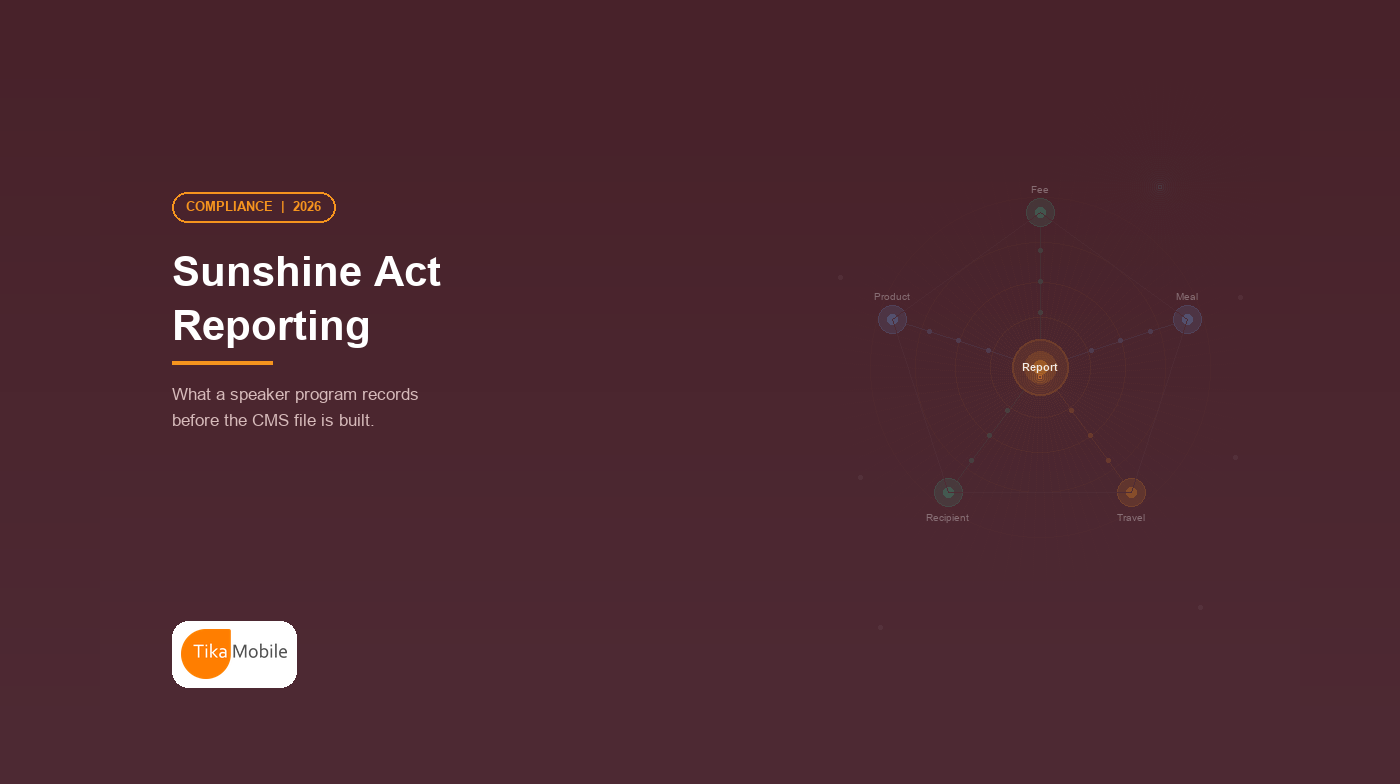
Sunshine Act reporting is the federal requirement, run by CMS as the Open Payments program, that applicable manufacturers of drugs, devices, biologics, and medical supplies report certain payments and other transfers of value to covered recipients. For a company speaker program that usually means the speaking fee, the meal, and any travel or lodging the company paid, each tied to a person and, where it applies, to a product. This post is about the record a program has to keep so that annual file can be built. The design of the program itself, the reason, the speaker, the room, and the pay, is covered in pharma speaker programs.
Quick answer: Open Payments wants a row for each reportable transfer from a speaker program: the speaking fee in its own nature-of-payment category, food and beverage for each covered recipient who received the meal, and travel or lodging when the company paid those separately. For payments made in 2026, a transfer under $13.82 is excluded unless that person's payments for the year cross $138.13, in which case the smaller ones are reported too. The submission deadline is 31 March of the following year, and the file counts as reported only after an authorized official attests to it.
Who reports, and about whom
Applicable manufacturers report. So do applicable group purchasing organizations. The recipients who put a speaker program into the file are the covered recipients in the room and on the contract.
Covered recipients are physicians and teaching hospitals. Beginning with program year 2021, CMS also treats physician assistants, nurse practitioners, clinical nurse specialists, certified registered nurse anesthetists, and certified nurse-midwives as covered recipients. A nurse practitioner who attends the dinner and eats the meal belongs in the food-and-beverage rows. A sales representative who eats the same meal does not. Staff are not covered recipients, and leaving them in the headcount is how a per-person meal value gets calculated against the wrong denominator.
The identity CMS expects is the one in the National Plan and Provider Enumeration System: legal name, NPI, specialty, business address, and state license number. A sign-in that reads "Dr. Patel, oncology" will not fill those fields in March. The NPI has to be captured while the person is there, or matched from a maintained list the same week, while someone can still tell two physicians with similar names apart.
The transfers a speaker program creates
A single dinner can produce several reportable transfers, and they do not share a nature-of-payment category.
The speaking fee is the payment to the person who presented. CMS has said that a payment for promotional speaking may be reported as compensation for services other than consulting, or as an honorarium, depending on the facts, and that the company may explain the choice in its assumptions document. Compensation for serving as faculty or as a speaker for a medical education program is a separate category. A company program, where the company chooses the speaker and controls the deck, is the promotional case. An accredited course the company funds without directing who speaks is a different set of rules, and CMS has said an unrestricted payment to a continuing-education provider is not an indirect payment just because the provider later pays a speaker.
The meal is food and beverage. It is reported to the covered recipients who received it, and it is not part of the speaking fee. Travel and lodging, when the company pays them as their own transfers, take the travel and lodging categories. A contract that pays one amount and calls the whole thing a speaking fee should say so in the assumptions statement, so the method is on the record when a recipient disputes the line nine months later.
If a vendor pays the speaker because the company required or directed that payment, the company still has the reporting obligation. The check changing hands outside the company's accounts payable system does not take the payment out of Open Payments.
What the March file cannot reconstruct
General-payment records ask for the amount, the date, the form of the payment, and the nature. They ask for the related covered drug, device, biological, or medical supply when the program has one. They ask how many payments the line represents. If the covered recipient directed the money to someone else, the record names that third party.
None of those fields can be invented from a calendar invite. The date of the program and the date of the payment are often different, and the file needs the date of the transfer. The product discussed that night has to be written down at the time, including for a talk that was framed as disease-state education and still centered on one covered product. A program with no related product should be marked that way on purpose, so March does not become a guessing exercise about which brand the slide deck belonged to.
The same event file is what an auditor asks for when the question is whether the program was a real educational event. How that design is judged, under the OIG's 2020 Special Fraud Alert and the PhRMA Code, is the subject of the speaker-programs post. The cap on what the speaker may be paid, and why a quarterly audit finds the breach after the money has moved, is covered in speaker bureau FMV monitoring. Open Payments does not set the fair-market-value rate. It reports the payment that was made.
Why a small meal still ends up in the file
CMS adjusts two thresholds every year with the consumer price index. For transfers made from 1 January 2026 through 31 December 2026, a payment under $13.82 is excluded from reporting. The exclusion drops away if the total transferred to, requested by, or designated on behalf of that covered recipient during the year exceeds $138.13. Once the annual total is crossed, the payments under $13.82 are reported along with the rest. Both figures are on the CMS data-collection page, and they apply only to 2026 activity. The 2025 thresholds were $13.46 and $134.54. The 2027 figures, already posted, are $14.31 and $143.01.
That is why a modest dinner is not safe to ignore. Allocated across the people who ate it, the meal can land under $13.82 for each covered recipient. The speaking fee paid to one of those physicians in October can pull every earlier meal for that person into the report. A team that drops sub-threshold meals out of the system in February will not have them in November, when the annual total trips the rule. The meal and the fee have to stay on the same person all year.
Bring one program from this quarter. Twenty minutes is enough to see the speaker, the meal, and the payment on the same record.
Book a 20-minute walkthrough →
When the file is due, and when it counts
Reporting entities submit the prior calendar year's data to Open Payments by 31 March. CMS's January 2026 tutorial for reporting entities lists 31 March 2026 as the submission point for 2025 payments and 30 June 2026 as the publication point, and it marks those dates as anticipated. Submission and attestation are not the same step. CMS treats the report as complete when an authorized official attests to the timeliness, accuracy, and completeness of everything submitted for that program year. An upload that nobody attested is not a filed report, and a late attestation can draw civil monetary penalties.
Covered recipients can review the data and dispute a line. The review window opens in April, and disputes have to be resolved in time if the correction is going to appear in the June publication. Changing a record after attestation, including a field, a publication delay, or a deletion, requires the company to attest again. The assumptions statement, a free-text note submitted with the attestation, is the place to explain how meals were valued or why a speaking payment was coded to one nature category. CMS does not publish that statement.
What the federal file does not replace
Some states keep their own limits on gifts to clinicians, or their own transparency reports, with different thresholds and different deadlines. A complete Open Payments submission does not satisfy those. In Europe, transfers to health professionals are disclosed under the EFPIA Disclosure Code, which names different recipients and runs on a different calendar. A compliance calendar that has only the CMS date on it is missing both.
Where speaker bureau software fits
Speaker bureau software is where the program, the speaker, and the payment can sit on one record while the year is still open. TikaSpeaker Bureau is TikaMobile's system for the programs a company runs, including dinner programs, advisory boards, and grand rounds. A program moves from planned through confirmed, completed, and evaluated. The speaker's contract, training, and credentials sit on the speaker. Attendance is recorded against the HCP's own profile. A completed event calculates the honorarium from preparation hours, service hours, and travel. The speaker confirms the invoice, and finance approves it against the cap.
Caps can be set annually, quarterly, and per event, by tier. The platform warns at 80 percent of a cap and blocks the payment at 100 percent. Going past the cap takes an exception that compliance reviews. Changes to an event, a contract, an invoice, or an exception are logged with the person and the time. It runs on its own or beside the CRM a company already has, including Veeva or Salesforce.
One limit belongs in the same paragraph as the capability. Automated CMS Open Payments export, EFPIA disclosure files, and state transparency reports are not in the product yet. The payment record is there, with the person, the program, the amount, and the cap check. The filing still runs through whatever process the company uses today. Do not plan a disclosure submission on an export from TikaSpeaker Bureau until that export exists.
Questions people ask
What does Sunshine Act reporting require of a speaker program?
Applicable manufacturers report payments and other transfers of value made to covered recipients. From a speaker program, that is typically the speaking fee, food and beverage provided to covered recipients who attended, and travel or lodging the company paid. Each transfer needs the recipient's identifying information, the amount, the date, the nature of the payment, and the related covered product when there is one. CMS runs the program as Open Payments.
Are meals at a speaker program reportable?
Yes, when the meal is a transfer of value to a covered recipient and the reporting thresholds are met. Food and beverage is its own nature-of-payment category, separate from the speaker's fee. For 2026, a transfer under $13.82 is excluded unless that recipient's payments for the year exceed $138.13, in which case the smaller transfers are reported too.
When is Open Payments data due?
Reporting entities submit the prior year's payments by 31 March and attest to the submission. CMS publishes the attested data in June, after covered recipients have a window to review and dispute. A file that was uploaded and never attested is not treated as reported.
Does the Sunshine Act set the speaker's fair market value?
No. Open Payments discloses what was paid. The rate itself is a fair-market-value decision the company makes, and it is the rate the OIG and the PhRMA Code expect to see defended. The payment record and the disclosure are two uses of the same number.
Does speaker bureau software file the Open Payments report?
TikaSpeaker Bureau does not. It keeps the program, the speaker, the invoice, and the fair-market-value cap on one record, and it warns at 80 percent of a cap and blocks payment at 100 percent. Automated CMS Open Payments export, EFPIA disclosure files, and state transparency reports are not in the product yet.
Before the next program is paid
Take the last program your team closed and see whether the file already has the NPI, the nature of each transfer, the related product, and the meal allocated to the covered recipients who received it. If any of those would have to be rebuilt from email, that is the gap to close before 31 March, not during attestation week. If you want to see the speaker, the payment, and the cap on one record, we can walk through a program you are running now.
Book a 20-minute walkthrough →
Sources
- Centers for Medicare & Medicaid Services. Data Collection for Open Payments Reporting Entities. Reporting thresholds for program years 2025, 2026, and 2027.
- Centers for Medicare & Medicaid Services. Open Payments Natures of Payment.
- Centers for Medicare & Medicaid Services. Open Payments Frequently Asked Questions. July 2024. FAQ 8382, nature of payment for promotional speaking. FAQ on unrestricted payments to a continuing-education provider.
- Centers for Medicare & Medicaid Services. Data Submission and Attestation for Open Payments Reporting Entities.
- Centers for Medicare & Medicaid Services. Open Payments Registration and Submission Tutorial. January 2026. Program year 2025 timeline, with anticipated dates.
Blog
November 2, 2026